GeoArabia Dashboard: Gaining Insights into the Geosciences of Arabia
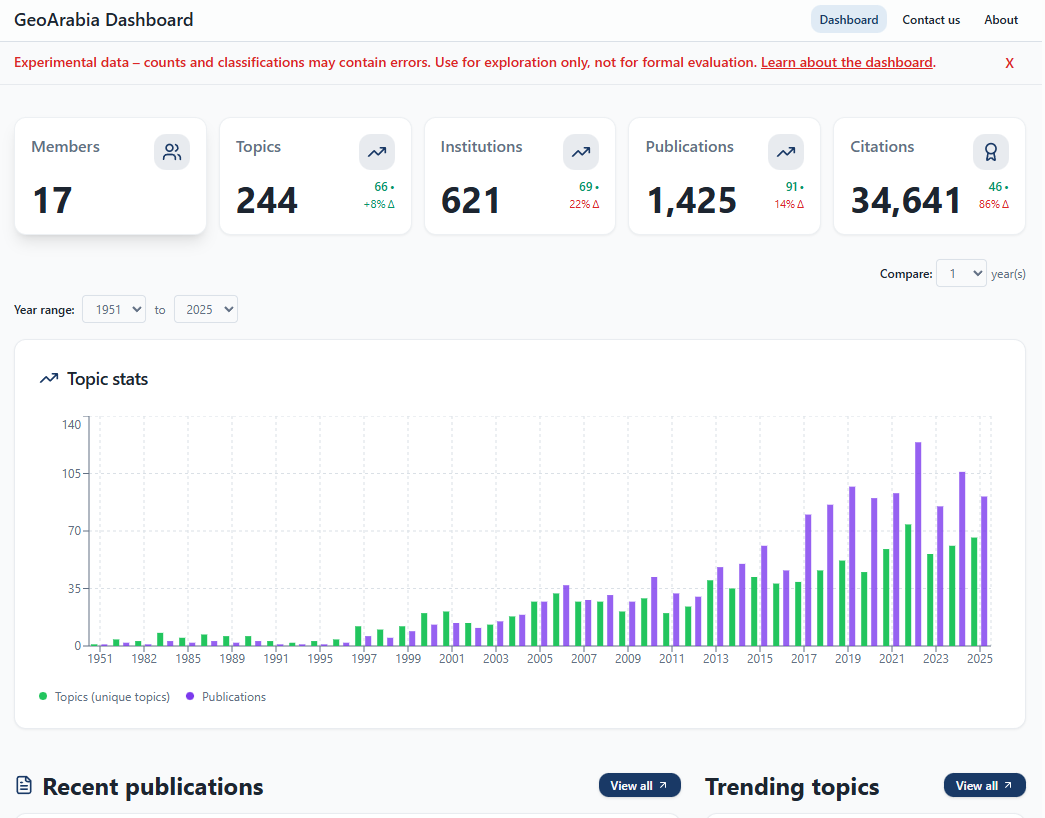
Understanding the landscape of geoscientific research in Arabia has long been hindered by fragmented data sources and limited access to comprehensive analytics. Previously, publications, authors, institutions, and thematic trends were scattered, making it difficult to derive strategic insights into the impact of Geosciences research in Arabia. The GeoArabia Dashboard ( GeoArabia.com/idb ) addresses the long-standing challenge of fragmented data access by enabling comprehensive analysis of Geoscientific research output in the region.
The GeoArabia Dashboard provides a transparent, data-driven view of research outcomes extracted from OpenAlex 1 , clarifying:
- Publication Metrics: Volume and trends over time.
- Research Evolution: Emerging topics and shifting research priorities.
- Collaboration and Impact: Author networks and contribution histories.
- Reach and Representation: Institutional involvement and geographic distribution.
- Thematic Shifts: Topic landscapes across decades.
The dashboard’s core purpose is to leverage historical insights to strategically shape the future of regional geoscience. It aligns with the Web-based Interactive Integrated Platform (WIIP) approach for integrating heterogeneous geological data into interactive web tools 2 . It uses the IDB (Interactive Dashboard) created by Digital Geosciences as the visualization tool, providing robust program-level, institutional, and author-centric analytics.
However, users should be aware of current data limitations, including:
- Last Name Disambiguation: Variations in name spellings across sources, as well as authors publishing under multiple name variants, may affect count accuracy.
- Co-author Graphs: These reflect cached OpenAlex snapshots 1 and may not include the most recent updates.
- Topic Counts: These represent the number of unique topics assigned to works, not the number of works themselves.
The plan to improve the GeoArabia Dashboard in the future includes, but is not limited to,:
- Performance: Persisting derived data in a lightweight offline database to accelerate large data refreshes.
- Quality Signals: Incorporating journal and venue quality indicators to enable filtering or summarization by ranking tier.
- Richer Analytics: Expanding analysis views so users can define custom slices based on year, topic, institution, and member.
🌍 Explore the GeoArabia Dashboard
Cite this post
If you found this post helpful, please consider citing it:
Alqubalee, A. (2025, December 12). GeoArabia Dashboard: Gaining Insights into the Geosciences of Arabia. ALQUBALEE Notes. https://qubalee.github.io/posts/2025/12/geoarabia-dashboard/
References
Priem, J., Piwowar, H., & Orr, R. (2022). OpenAlex: A fully-open index of scholarly works, authors, venues, institutions, and concepts. ArXiv. https://arxiv.org/abs/2205.01833 ↩︎ ↩︎2
Alqubalee, A. (2025, April 8). WIIP: An Approach for Leveraging Geological Data Heterogeneity through Customization of Open-Source Software. https://qubalee.github.io/posts/2025/04/wiip/ ↩︎